
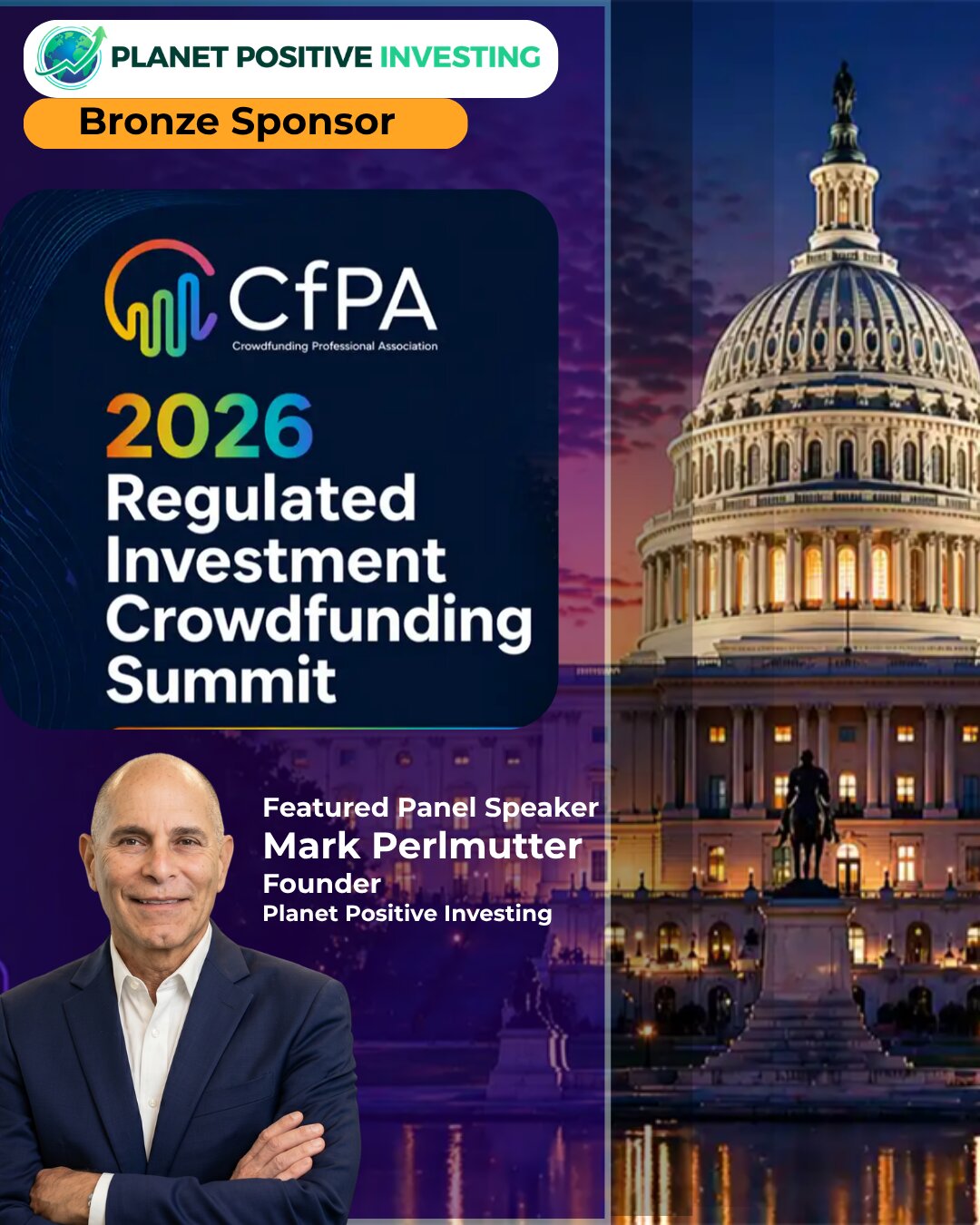
2026 CfPA Regulated Investment Crowdfunding Summit
Planet Positive Investing is proud to announce our Bronze Sponsorship of the premier national conference for equity crowdfunding in Washington, D.C.
"Side-By-Side Offerings: Bridging the Retail & Institutional Divide"
Speaker: Mark Perlmutter, Founder & CEO of Planet Positive Investing
- Date & Venue: October 20–21, 2026 · Washington, D.C.
- Core Mission: Erasing the crowdfund return gap by pairing crowd investors with institutional leads via SEC Rule 3a-9.
- Democratized Terms: Members invest from as little as $100 on identical terms as tier-1 venture funds.
A 30-Year Perspective: From the 1995 Internet Roadshow to Title III
To understand why the future of equity crowdfunding belongs to side-by-side offerings, one has to appreciate how online capital formation began. Speaking to an audience of securities attorneys, funding portal operators, and broker-dealers in Washington, D.C., Planet Positive Investing founder Mark Perlmutter took the room back to 1995.
Three decades ago, Perlmutter pioneered one of the very first public offerings announced directly on the World Wide Web. Raising an average of $450 from 3,500 everyday people, the experiment startled Wall Street. Shortly thereafter, representatives from securities associations and the SEC invited him on a nationwide educational roadshow across the United States to explore a radical question: What is the purpose of online capital formation? Is it merely to give startups another place to raise money—or is it to bring tens of millions of everyday citizens into the wealth-creation process of early-stage private equity?
That question echoes even louder today.
The 10-Year Crowdfunding Experiment & The Unspoken Return Gap
In 2016, Title III of the JOBS Act officially opened startup investing to the general public. Over the ensuing decade, more than 1.5 million Americans have opened accounts on regulated funding portals to back visionary entrepreneurs.
It was an undeniable democratic milestone. Yet, when we examine the empirical financial returns of retail-only equity crowdfunding rounds with unsparing honesty, a troubling pattern emerges: the financial performance of retail-only crowdfund offerings has dramatically lagged behind the broader public markets, failing to match even standard S&P 500 index returns.
The Problem: The Retail-Only Trap
Why have retail-only offerings struggled so severely? Because early-stage startup investing is inherently high-risk, and professional venture capitalists spend hundreds of hours conducting exhaustive technical, intellectual property, and financial due diligence before wiring a check. More importantly, institutional investors negotiate protective governance rights: liquidation preferences, anti-dilution protections, pro-rata rights, and board observation seats.
In sharp contrast, typical retail-only crowdfunding campaigns suffer from three structural flaws:
- Inflated, Uncontested Valuations: Pre-money valuations are often set unilaterally by founders on marketing optimism rather than institutional financial analysis.
- Subordinated Paper & Dilution: Retail backers frequently receive common stock or non-voting SAFEs with zero pro-rata protections, leaving them completely vulnerable to future recapitalizations.
- Adverse Selection: Too many companies have turned to retail crowdfunding only after being evaluated and passed over by reputable venture capital firms.
The result is a return gap that damages investor trust. Millions of everyday Americans who genuinely want to deploy their hard-earned dollars into climate solutions and green technology have been burned by unrepresented, retail-only deal flow.
The Empirical Proof: What 10 Years of UK Crowdfunding Data Tells Us
During the panel, Perlmutter cited the most compelling longitudinal data available in the global equity crowdfunding industry: a comprehensive 10-year study tracking early UK crowdfunding offerings.
The research analyzed hundreds of startups over a decade and uncovered a stark, black-and-white truth: there was a near 0% failure rate among crowdfunded companies that had a professional institutional lead investor involved on the board, compared to a massive failure rate among companies backed solely by retail crowds.
When seasoned professionals conduct due diligence, price the round fairly, and take board seats to guide the company toward a 5-to-7 year liquidity event, startups survive and scale. Without that institutional anchor, companies often run out of cash or dilute early backers to zero.
The Psychological Breakthrough: "Nobody Wants to Be First Dollar In"
Fellow summit panelists highlighted a key psychological barrier in equity crowdfunding: "Nobody wants to be the first dollar in."
When an everyday individual visits a crowdfunding portal for the first time, evaluating a startup's balance sheet, market dynamics, and competitive moats is daunting. But when that individual sees that a respected venture fund or family office has already anchored the financing round with significant institutional capital, the psychological barrier evaporates.
For founders, fundraising is an exhausting, 40-to-50-hour-per-week job that detracts from building product and serving customers. A side-by-side offering gives founders the ultimate dual-track advantage: they secure substantial institutional capital to fund growth, while simultaneously mobilizing thousands of passionate customer-investors who act as authentic brand champions.
The Legal Engine: How SEC Rule 3a-9 Unlocks the Interlocked SPV™
How do we legally pool thousands of non-accredited club members into a vehicle that mirrors a venture capital round? The secret lies in a precise statutory mechanism: Rule 3a-9 of the Investment Company Act of 1940.
Under traditional securities law, pooling non-accredited investors into a Special Purpose Vehicle (SPV) would trigger burdensome registration requirements under the 1940 Act, effectively shutting out everyday participants. Rule 3a-9 provides an explicit regulatory pathway allowing structured Crowdfunding Vehicles (SPVs) to mirror the economic terms of an underlying professionally-led round without treating the entity as an investment company.
To operationalize this, Planet Positive Investing engineered two trademarked investment structures: the Interlocked SPV™ and the Tethered SPV™.
| Offering Element | Retail-Only Crowdfund | PPI Interlocked SPV™ |
|---|---|---|
| Lead Investor Due Diligence | Crowdsourced; no institutional audit | Selected & audited by Tier-1 professional venture funds |
| Valuation & Terms | Set unilaterally by founder; often inflated | Negotiated by professional lead investors |
| Downside Protection | Common stock or non-voting SAFEs | Preferred stock terms matched to institutional lead |
| Anti-Dilution & Governance | Vulnerable to recapitalizations & reverse splits | Protected by professional board observation & pro-rata rights |
| Minimum Ticket | $100 – $500 | As little as $100 |
| Historical Survival Rate | High failure & dilution rate | Near zero historical failure rate with institutional backing |
Ending the "40:1 Reverse Split" Trap
One of Perlmutter's most crucial warnings during the panel addressed downstream dilution:
Without protective covenants, an early crowd investor who backed a startup at an inflated cap can be wiped out in subsequent down-rounds or structured recapitalizations. By anchoring the Interlocked SPV™ directly to the institutional preferred stock terms, crowd members receive the exact same liquidation preferences and anti-dilution shields as the lead venture fund.
Exits, Not Forever Investments: Targeting 5–7 Year Liquidity
A central insight from the panel was the critical distinction between a donation and an investment:
Startup investing cannot be a "forever investment" with no horizon for returns. Everyday Americans deploying hard-earned savings need a realistic roadmap to liquidity. The only reliable mechanism to ensure a company works toward a liquidity event is having a seasoned professional on the board whose fund's financial incentives are explicitly tied to achieving an exit (acquisition or IPO) within 5 to 7 years.
When the venture lead's fund lifecycle demands liquidity, the crowd's Interlocked SPV™ participates in that exact same liquidity waterfall.
The Road to 20 Million Americans & Unlocking Retirement Capital
Looking ahead to the next five years, the panel discussed the broader horizon for the crowdfunding industry. Today, approximately 1.5 million Americans have participated in equity crowdfunding. But to build a truly vibrant, self-sustaining entrepreneurial economy, the industry must scale to 20 million to 50 million participants.
The vast majority of household wealth in America sits in retirement accounts—traditional IRAs and 401(k)s. Everyday citizens are eager to allocate a small percentage of their retirement savings to solutions addressing the climate emergency. But they will only do so if the investment vehicles provide the institutional diligence, transparent governance, and downside protections they expect.
By educating founders, portal operators, and investors on SEC Rule 3a-9, Planet Positive Investing is turning side-by-side offerings into the standard of the industry.
Join 30,000+ Members Backing Selected Climate Solutions
Get exclusive alerts when institutional-grade climate startups open side-by-side community rounds starting at $100. Always 100% free to join.
Join the Free Investor Club →