
Let me start with a fun fact. Every product in the world around us needed industrial heat to make it.
Think about it — the paper in your books, the screen on your phone, the food in your kitchen, the pharmaceuticals in your medicine cabinet. Industries burn fossil fuels to generate the heat needed to make these things for us. That burning builds our economy. It also creates one of the biggest sources of pollution on the planet — and one of the largest expense items on a factory's books.
That's the problem Airthium is solving.
The Invisible Pollution Problem Nobody Talks About
Most climate conversations focus on cars, planes, and power plants. But industrial process heat — the heat used to manufacture everything from paper to pharmaceuticals to chemicals — is responsible for roughly 20% of global CO₂ emissions. It's one of the hardest sectors to decarbonize, and one of the least discussed.
The reason it's hard is straightforward: factories need extreme temperatures — often 400°C, 500°C, or more — to run their processes. Conventional industrial boilers burn oil, gas, or coal to reach those temperatures. Nothing else has been cheap enough or reliable enough to replace them. Until now, the choice for a factory manager has essentially been: keep burning fossil fuels, or shut down production.
That's not a real choice. So most factories keep burning.
"Industries burn fossil fuels for the heat needed to make goods for us — which builds our robust economy. Unfortunately, industrial process heat is one of the biggest sources of worldwide pollution. And it's also one of the largest expense items on a factory's books."
What Airthium Actually Built
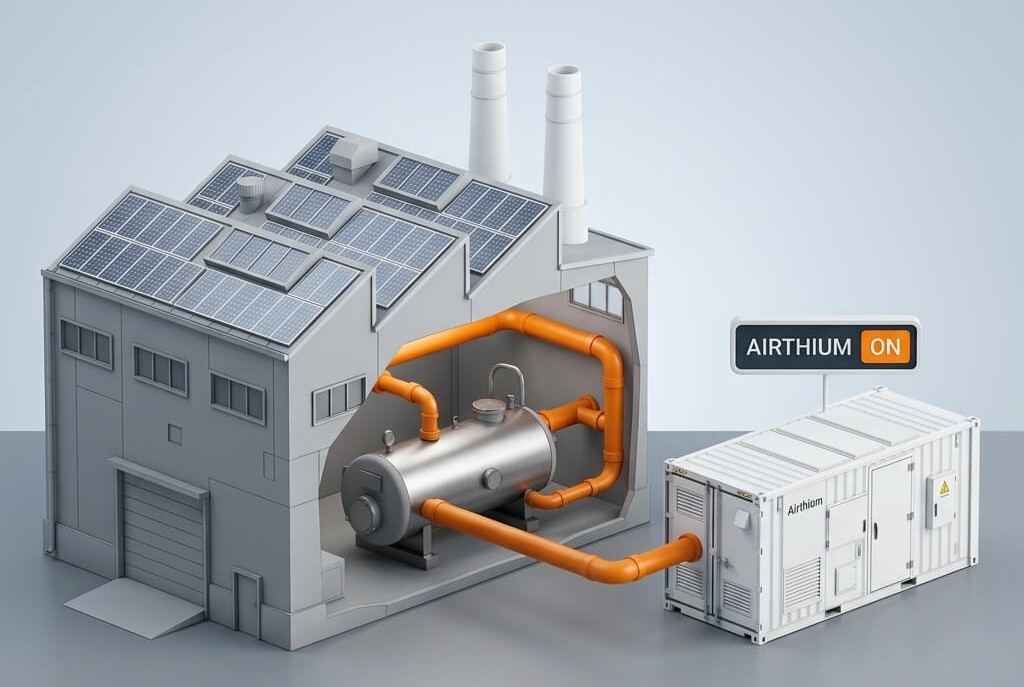
Airthium has built a containerized, plug-and-play heat pump that sits outside a factory, connects directly to the existing gas boiler, and begins supplying industrial heat — without disrupting production for a single day.
The technology taps the earth's deep geothermal heat and uses an industrial-scale heat pump to amplify it to the extreme temperatures factories need. Factories don't need to rip anything out. They don't need to retrain their staff. The unit arrives in a self-contained shipping container, is installed outside the building, and connects to what's already there.
What makes it genuinely clever is the software layer. Airthium's proprietary system monitors energy pricing every 15 minutes. When electricity is cheaper, Airthium runs. When gas is cheaper, the boiler takes over. The factory always gets the better price. Over time, as renewable electricity gets cheaper and carbon taxes keep rising, Airthium's economics only improve — not weaken.
Three Things That Got My Attention
When I evaluate a deep-tech company, I'm looking for signals that the technology is real, that serious people have validated it, and that real customers are waiting. With Airthium, I found all three.
First — the French government did a rigorous technical audit and awarded Airthium 4 million USD in R&D grants. Governments don't hand out millions of dollars without scrutiny. This means independent scientists reviewed the physics, the engineering, and the feasibility — and said: this works. That kind of institutional validation is rare at this stage.
Second — Y Combinator invested. Y Combinator is the most respected startup accelerator in the world. They backed Dropbox, Airbnb, and Stripe. They don't invest in companies with shaky technology. When YC puts money in, it means people who've seen thousands of pitches from the sharpest engineers on earth decided this team and this technology are worth backing. Combined with additional VC investment, Airthium raised over 10 million USD before this crowdfund ever opened.
Third — a real chemical factory ordered an installation. A customer needing to reduce emissions signed on. That's not a letter of intent or a partnership announcement. That's a factory that looked at the technology, ran the numbers, and said: we want this. Smart investors validated the physics. A real business customer said they're ready. Both in the same company — at this stage — is a genuine signal.
"To me this says smart investors validated the physics, and business customers are ready. Seeing both in a deep-tech company is a sign — and Airthium has them."
The Scale of the Opportunity
The market Airthium is entering is staggering. Across the globe — paper mills, food processing plants, chemical manufacturers, pharmaceutical factories, construction material producers — nearly all of them run fossil fuel boilers. Nearly all of them could use Airthium's system.
The global industrial heating equipment market is valued at $75.5 billion and growing at over 5% annually. And the economics are moving entirely in Airthium's direction: solar and wind electricity prices fall every year, carbon taxes expand every year, and regulatory pressure on industrial emissions only intensifies. The longer you wait to decarbonize a factory, the more it costs. Airthium removes that excuse.
Their business model is also structured in a way that removes the biggest barrier to customer adoption: upfront cost. Under their Heat-as-a-Service model, Airthium owns the unit. The factory pays only for the heat it consumes, and only when Airthium's price beats gas. Zero upfront cost to the customer. Long-term recurring revenue for Airthium. It's a model that's worked in solar — and it's exactly the right structure for this market.
What I Want You to Understand About This Investment
I'll be honest with you, because I always am.
This is deep tech. The timeline to first commercial deployment is 2028–2029. This is not a quick flip. You're not going to see a return next year, or the year after. What you're doing if you invest is making an early-stage bet on a team, a technology, and a market all moving in the same direction at the same time.
I approach opportunities like this the same way professional venture capitalists do. I diversify — because the math requires it. Most early-stage companies won't make it. But if one company in a portfolio turns out to be right about something this big, the upside is significant. Airthium feels like that kind of early entry point to me.
Their CEO has said they finished testing and are now beginning to build units for their first customers. That's the moment — before the commercial rollout, before the press coverage, before it's obvious.
Their community round is open now on Wefunder, with a minimum investment of $250. As always, before you invest, read all the offering information on the portal and make your own decision. But if you're going to look at one company this month, look at this one.
And after you do — drop me an email and tell me what you found notable. I always read those.
View Airthium on Wefunder
Their community investment round is open now. Read the full offering, review the team, and decide if this is a bet you want to make alongside Y Combinator.
Invest in Airthium on Wefunder →When investing, your funds are at risk. Read the full offering information on the Crowdfund portal before making up your mind. Planet Positive does not give advice and this article should not be considered investor advice. Our communications are notifications of public information displayed on registered portals. If you have any questions about our role, reach out to us.
DisclosurePPI uses best practices in transparency with you, our members, as we pursue our mission of growing the sustainable economy. We received fees from Airthium for announcing this crowdfund to our members. We choose these companies because we believe they can make an impact. You make your own decisions on each company you learn about from us. We do not receive commissions, we do not handle your funds, and we do not charge you fees. Once you receive this announcement you must link to the regulated portal to see all the offering information. We are happy when impact startups receive backing to expand — this furthers our goal to accelerate the impact economy. 8/13/26